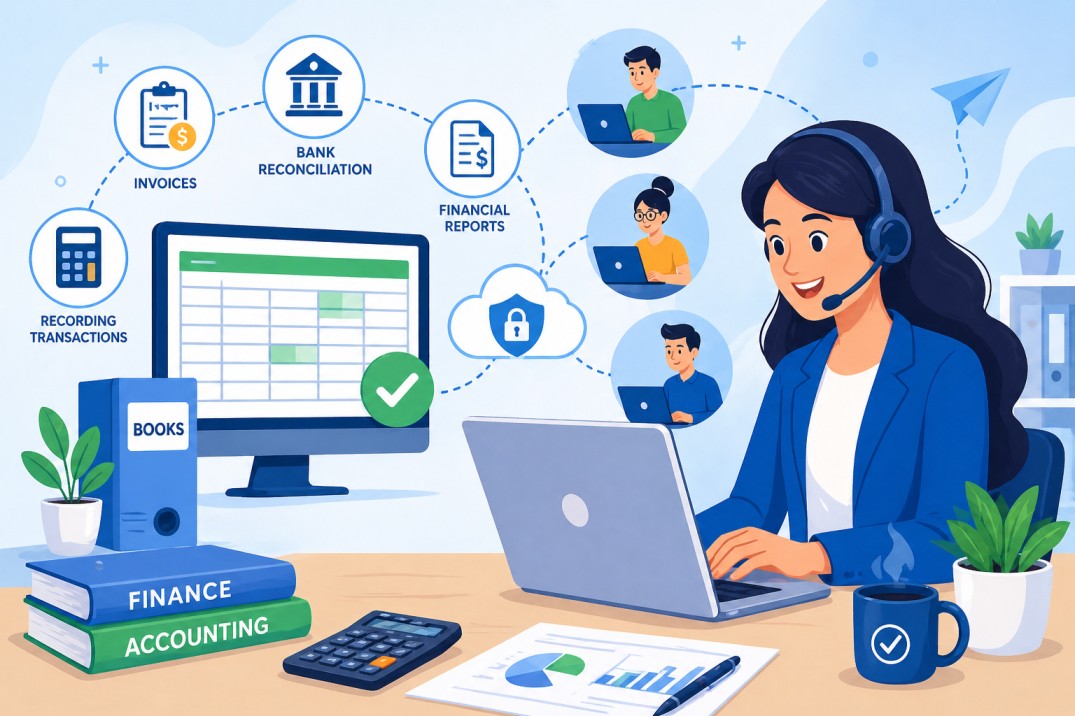


Outsource Bookkeeping to Virtual Finance Experts 

 Outsource Bookkeeping to Virtual Finance Experts 

It’s a quiet Sunday night, meant for rest but stolen by numbers. A spreadsheet refuses to add up properly. Somewhere, a missing receipt from weeks back hides like buried treasure. Suddenly, taxes loom while your records trail behind, slow and messy. This weight, heavy in the chest – irritation mixed with exhaustion – tends to stir thoughts. Hiring someone far away who handles money tasks begins to make sense. Here’s the truth. Most expanding companies find it makes real dollar sense. Think of it less as an option, more as a smart money move.               

The Hidden Cost Of Doing It Yourself        

Truth is, managing your books yourself? Not really free. Takes hours. Hours you could spend elsewhere. For someone running a business, that time matters more than cash. Each minute adds up, quietly slipping away.  

 Starting at your desk with receipts and spreadsheets means less time knocking on doors, making deals, or planning what comes next. Those minutes stack into full days before you notice. Picture tallying entries instead of talking to customers – five, maybe fifteen hours each month vanishing like steam. Run the math yearly, tag each hour with what it truly costs, then compare that number to what an expert charges online. Surprise? Sticking to self-managed books often burns deeper holes in your pocket than hiring help ever could.  

 Accuracy matters more than it seems. One mistake early on grows worse over time. A single wrong label on an expense from winter might twist the full three months’ results. Forget to claim what you could deduct, then hand extra money back at tax time. Track customer payments poorly, that income slips through fingers like sand. Hand financial tasks to someone without proper training – even if sharp in their own field – risks slipping into costly missteps.  

 Out there, online bookkeeping cuts the danger completely. Working with a remote money team means your numbers go to people focused on just one thing – tracking finances. These folks live inside accounting tools, understand rules down to the details, spot warning signs fast. Deep focus like that makes a real difference.             

Virtual Bookkeeping in Real Use     

Out there, plenty think handing tasks to others means wading through red tape. Slow replies creep into the workflow like weeds. Nameless offices far away seem clueless about real goals. Times changed though.  

 These days, online bookkeeping runs smooth. Through tools such as Xero, QuickBooks Online, or FreshBooks – familiar names for many small firms – tasks move fast. Connected to your system, your remote helper pulls in data, matches records, begins sorting things out. No mailing documents back and forth, no long check-ins booked on calendars, no tracking someone down just to know what’s new. All pieces sit up there, stored where you can reach them whenever it suits you.  

 Every now and then, messages pop up through email or chat tools – sometimes they land in special online spaces made just for clients. Reports arrive each month like clockwork: income minus costs, what the business owns versus owes, money moving in and out. These come without delay. When doubts arise, replies show up fast. A solid remote bookkeeper spots odd entries before you even see them, speaking up right away instead of staying quiet.  

 Out there, remote bookkeepers often know the ins and outs of particular industries. Running an online shop? A clinic? Maybe a building outfit or advisory service? Chances are someone handling books from afar has already tackled similar work. This background plays a role – how numbers get sorted, what gets written off, reports shaped around real daily operations. Details line up better when experience matches reality.   

The Scale Beyond What Internal Bookkeepers Achieve 

Some companies benefit from having an employee who handles books on site. Yet that setup means steady expenses, regardless of how busy things get. Pay continues during quiet periods just as much as during peak times. When illness strikes, vacation plans kick in, or someone leaves the role suddenly, work often stalls until another person steps in.  

Outsourcing bookkeeping to remote experts means your support grows when your workload does. Facing a busy season? Adding help feels natural. Working through slower months? There is no need to pay for someone sitting idle. Such adaptability matters most for ventures with fluctuating cycles, new enterprises finding footing, or organizations shifting into different phases.  

 When you hire virtual bookkeepers, backup support comes standard. Instead of relying on one person, there’s a whole group behind the work. Should your main point of contact be out, another skilled member takes over seamlessly. Updates keep flowing, due dates are still hit, reports roll out like clockwork. Even if plans shift, nothing falls through the cracks.  

Real-Time Financial Visibility Shifts Decision-Making      

Out there among remote finance pros, fresh eyes bring sharper clarity – suddenly numbers make sense like never before. Sometimes it just takes distance to see clearly.  

Running your own books often means seeing finances from weeks ago, sometimes even months back. Because of this gap, choices about prices come not from fresh numbers but gut feelings instead. Staff hires follow the same pattern, guided more by guesswork than real-time figures. Investments go forward without clear support from up-to-date reports. Danger hides in those delays – acting blind is never safe.  

Every week – sometimes every day – someone watches your money numbers closely. With fresh records, reports start making sense instead of just sitting there. Profit by profit, you notice which parts of the business really pull their weight. Costs that sneak upward? They show themselves fast. Trouble with cash appears early, giving room to shift gears before things tighten.  

 This kind of live money insight changes how companies make choices. Picture moving forward with full sight instead of guessing from outdated directions.      

Compliance & Tax Preparedness Bring Peace of Mind        

That time of year arrives. Messy books turn into long nights fixing what should’ve been logged months ago. When receipts vanish, someone always asks why things are missing – auditors might too. Slap a wrong label on a payment? Say goodbye to write-offs. Or face explaining choices that crumble when checked.  

Kept up to date, virtual bookkeeping makes sure your money details stay ready for taxes at any time. Right away, each transaction finds its proper place. Because every receipt gets saved and tied directly to the matching record. When it comes time for year-end reports, everything flows smooth instead of falling into disarray.  

When tax season comes around, digital finance specialists often team up tightly with CPAs. This teamwork keeps everything moving smoothly. Records arrive neat and correct. That leaves your accountant free to plan ahead. Fixing errors takes less time. Strategy becomes the main task instead.  

 When companies work in more than one state or sell online, having skilled virtual bookkeepers helps them follow complex tax rules. Meeting deadlines for reports matters because mistakes could mean fines big enough to harm a small operation.   

Selecting a Virtual Bookkeeping Partner   

Some online bookkeeping options stand out more than others, which makes careful choice matter. Credentials can tell a story – think Certified Bookkeeper status, ties to QuickBooks as a ProAdvisor, or links to known finance groups. Their background with companies like yours – same scale, same field – deserves a question or two.  

Focusing on how they talk matters just as much as what they say. A solid virtual finance team acts less like a distant processor and more like someone who’s actually involved. When updates follow a steady rhythm, messages come through without waiting, while numbers get broken down in everyday words – that’s when it clicks. Real clarity shows up not in jargon but in patience, timing, and openness.  

 Fair point – safety counts just as much. Find out how they guard information, whether files move in scrambled form, or who gets permission to view what. Money details are private stuff. Good online bookkeepers act like that’s obvious.  

 Some plans ask for one price each month; meanwhile, a few tally up costs based on how much you use. Look close at which features come standard, when extra charges kick in, also what kind of updates and summaries they provide. Value shows up when the help you get lines up with what you pay.       

Final Thoughts       

Out there, handing off bookkeeping to remote finance pros? Not losing control. Gaining ground instead – hours in your day, sharper numbers, clearer insight, maybe even some calm in the chaos. Companies aiming higher see one truth: accurate records managed by trained hands aren’t optional extras. They’re what solid choices grow from. Let those who eat, sleep, and dream spreadsheets handle the ledgers. You turn toward what pulls your venture ahead.   

Voxtend Virtual Assistant Services

Regardless of the size of the business you representIf you’re considering hiring finance assistants for your projects, VoxtenD is here to help. Our suite of VA services covers all aspects of bookkeeping and beyond, ensuring that your business gets the help it needs, no matter the size or needs of your business. With round-the-clock availability, VoxtenD is your partner in achieving business success. Contact us today to explore how our services can benefit your business. 

Learn more about Voxtend VA services →   |   Get in touch with our team

Cost Savings with Offshore Virtual Employees in 2026

Cost Savings with Offshore Virtual Employees in 2026

At some point, most business owners do the same mental math. You’re looking at your payroll, benefits, office overhead, and all the little costs that never seem to make it into the original budget. And then someone mentions hiring a virtual employee overseas, and you think: is this actually as good as it sounds, or is there a catch?

Here’s the short answer: for a wide range of roles, the savings are real. Not “we trimmed a little” real. Genuinely, structurally significant savings that show up in the numbers every month. Businesses that switch to offshore virtual employees typically reduce labor costs by 60–78% compared to hiring locally in the US, UK, Canada, or Australia. That’s not a rounding error. That’s a different way of building a team.

But cost isn’t the only story here. The longer answer involves understanding what you’re actually getting, where the savings come from, which roles work well, and how to avoid the mistakes that turn a great idea into a frustrating experiment. That’s what this guide covers.


Table of Contents

  1. The real cost of hiring locally
  2. Beyond the pay cut: the savings no one talks about
  3. Which roles offshore best in 2026?
  4. Where to hire: top offshore regions compared
  5. What about quality and communication?
  6. Legal compliance and staying protected
  7. How to build an offshore team that actually delivers
  8. Frequently asked questions
 

The Real Cost of Hiring Locally

The salary listed in a job posting is almost never what a hire actually costs. In the United States, Canada, or the UK, what you pay on paper and what you actually spend can look very different once the full picture comes together.

Factor in employer-side payroll taxes, health and dental insurance contributions, paid leave, retirement plan matching, workers’ compensation, and recruiting fees (agencies typically charge 15–25% of the first year’s salary), and the true cost of a local employee usually runs 1.25 to 1.4 times their base salary — sometimes higher in expensive urban markets.

Here’s what that looks like in practice:

  • A US-based customer support agent at a $45,000 salary costs the business closer to $55,000–$63,000 annually, all-in.
  • A full-time administrative assistant in the US runs $3,000–$4,000 per month in total cost.
  • That same role filled by a skilled offshore VA typically costs $800–$1,200 per month.

That’s a saving of over 70% on a single role. Across a team of four or five, that’s a completely different budget reality.


Beyond the Pay Cut: The Savings No One Talks About

The hourly rate difference is the obvious part. But there’s a second layer of savings that’s easy to miss until you’ve actually made the shift.

Office and equipment costs go away. When your team works remotely overseas, there’s no desk to assign, no computer to provision, no utility cost per head. For businesses in expensive city centers, that alone can save thousands per person annually.

Recruiting costs drop significantly. The Philippines, India, and Latin America have established pipelines of pre-vetted, experienced remote workers. Roles that take weeks to fill locally can be staffed in days through a trusted offshore agency. You skip the long recruitment process and most of the trial-and-error that comes with it.

Turnover costs shrink. This one surprises people. Replacing a mid-level employee in the US can cost anywhere from 50% to 200% of their annual salary once you account for lost productivity, rehiring, and retraining. Offshore team members, especially those hired through structured, ongoing arrangements rather than one-off gigs, tend to stay longer. Stability isn’t guaranteed, but the data consistently points that way.

Training time is often shorter than expected. Experienced offshore VAs, particularly those who’ve worked across multiple clients and industries, often arrive with broad professional exposure. They’ve adapted to different communication styles, different tools, and different workflows. That cross-industry experience is more useful than it might first appear.


Which Roles Offshore Best in 2026?

Not every role is equally well-suited to remote offshore work. The ones that work best share a common trait: they’re task-driven, process-friendly, and don’t require physical presence. In 2026, the list of roles that qualify is longer than most people assume.

Customer Support — Email, chat, and phone support remain among the most widely offshored functions. Skilled agents from the Philippines or Latin America handle customer inquiries, resolve issues, and manage tickets at a fraction of the cost of local hires, often with high satisfaction scores when properly trained on brand voice and product knowledge.

Administrative and Executive Assistance — Calendar management, email triage, travel coordination, data entry, report preparation. These are roles where a good VA quickly becomes indispensable. I’ve seen business owners go from skeptical to completely reliant within the first three months of working with a well-matched offshore assistant.

Digital Marketing and Content — Social media management, blog writing, newsletter scheduling, SEO research, ad management. These roles have proven highly effective offshore, particularly with clear brand guidelines and regular creative briefs in place.

Bookkeeping and Financial Administration — Accounts payable and receivable, payroll processing, bank reconciliation, financial reporting. Offshore bookkeeping has been a mature, well-proven category for years. Accuracy and reliability are consistently strong when handled by trained specialists.

Healthcare Administration — Medical billing, coding, patient scheduling, prior authorizations, insurance follow-up. Healthcare virtual assistants work within HIPAA-compliant frameworks, handling the administrative load that drains clinical staff without replacing the in-person care work.

Tech and Software Support — QA testing, junior development, technical customer support, data analysis. India and Eastern Europe particularly shine here, with talent that’s genuinely competitive at a global level.


Where to Hire: Top Offshore Regions Compared

The “hire offshore” category isn’t a single market. Different regions offer different strengths, and the right choice depends on what you’re trying to accomplish.

The Philippines consistently tops the list for customer service, virtual assistance, and administrative work. English fluency is strong and widespread. Work culture aligns closely with Western business norms. Rates typically run $600–$1,200 per month for experienced professionals, which represents significant savings versus equivalent roles in the US or UK. The global virtual assistant market, much of which runs through the Philippines, is projected to exceed $36 billion in 2026 — this isn’t a niche trend.

India leads in tech, finance, software development, and data work. Credentials are strong, and experience at the professional level is genuinely competitive globally. Rates vary by specialty but remain well below equivalent Western costs, often by a factor of three to five.

Latin America — Colombia, Mexico, Argentina — has become increasingly popular for US businesses, and it’s easy to see why. Time zone overlap with North America is excellent, Spanish-English bilingual professionals are in good supply, and rates run 40–60% below US levels. It’s a quieter shift than the Philippines-to-India story, but the momentum is real.

Eastern Europe — Poland, Romania, Ukraine, the Czech Republic — remains a go-to for technical roles. Software engineers, data scientists, and cybersecurity specialists from this region bring sharp skills and work hours that align reasonably well with Western Europe. The cultural fit for European businesses is often seamless.

There’s no single correct answer here. Most businesses settle on one or two regions based on the specific roles they’re hiring for. Many find that pairing a Philippines-based VA for support and admin with an India-based specialist for technical work gives them the best combination of coverage and cost.


What About Quality and Communication?

This is the question that comes up the most, and it deserves an honest answer rather than a sales pitch.

Yes, outcomes vary. Companies that rush offshore hires, provide minimal onboarding, set vague expectations, and check in sporadically often end up frustrated. That’s not a problem with offshore talent — it’s a management problem that would cause the same results with any team, local or remote.

Companies that treat offshore employees as real team members — with proper introductions, documented processes, clear communication channels, and consistent feedback — almost always report strong results. By 2026, the remote collaboration tools available make geographic distance nearly irrelevant for most task types. Project management dashboards, video check-ins, shared documents, and asynchronous communication platforms have closed most of the practical gaps that existed a decade ago.

One thing worth noting: offshore team members who work across multiple clients and industries often bring a breadth of perspective that’s genuinely valuable. They’ve handled different communication styles, adapted to varying work cultures, and navigated diverse client needs. That’s not a consolation prize for lower cost — it’s an actual advantage in many roles.

There’s no perfect answer here, but the evidence is clear: with the right setup, offshore virtual employees perform. The setup is the work.


Legal Compliance and Staying Protected

One of the legitimate concerns around offshore hiring is legal complexity. International labor law is genuinely complicated, and the rules vary significantly by country.

The simplest path for most businesses is to work with a reputable staffing agency or employer-of-record (EOR) service. These companies manage employment contracts, local payroll, tax compliance, and statutory benefits on behalf of the worker in their home country. You get the talent without needing to become an expert in Philippine or Colombian labor law.

  • EOR services typically cost $500–$2,000 per employee per month, but they absorb all compliance risk and administrative overhead.
  • Managed staffing agencies like Voxtend handle this structure for you, often at a total cost that’s still far below what you’d pay for an equivalent local hire.
  • For businesses working with multiple offshore staff, this structure creates a clean, auditable employment arrangement that protects both sides.

The compliance question is real, but it’s also solvable. Don’t let it be the reason you avoid a genuinely useful strategy.


How to Build an Offshore Team That Actually Delivers

The companies getting consistent, long-term value from offshore virtual employees share some common habits. None of them are complicated. Most of them are just good management practice applied at a distance.

  • Document processes before handing them over. If a task exists only in someone’s head, offshoring it will create problems. Write the steps down first. This also forces you to clarify what “done” looks like.
  • Invest in proper onboarding. Treating an offshore hire like a temp who should figure things out on their own is a reliable path to disappointment. A few extra hours upfront explaining your brand, your voice, your tools, and your expectations pays back over months.
  • Establish regular communication rhythms. Not just task assignment — actual check-ins that build professional trust over time. Weekly video calls, quick daily status updates, whatever fits the role. The goal is connection, not surveillance.
  • Set clear performance metrics from day one. What does good work look like in this role? How will you measure it? Clarity here prevents almost every common offshore frustration.
  • Treat them as long-term contributors, not disposable contractors. The offshore employees who grow into genuinely invaluable team members are almost always the ones who feel that investment from the employer’s side.

The businesses reporting the best results from offshore staffing have typically been doing it for two, three, or four years. Early friction is almost always process and communication friction — and both of those are fixable.


Ready to start saving with a dedicated offshore virtual assistant?

Voxtend connects businesses of every size with skilled, fully vetted virtual employees across customer support, administration, marketing, bookkeeping, and more. No long contracts, no overhead, just reliable talent that’s ready to work.

Explore Voxtend Virtual Assistant Services →


Frequently Asked Questions

How much can a business save by hiring an offshore virtual employee in 2026?

Businesses typically save 60–78% on labor costs compared to hiring locally. A full-time US-based administrative assistant costs $3,000–$4,000 per month in total employer cost. An offshore VA with comparable skills runs $800–$1,200 per month. Annual savings per role often exceed $25,000 once you factor in benefits, overhead, and recruiting costs.


Which countries are best for hiring offshore virtual employees?

The Philippines leads for customer service, admin, and virtual assistance. India dominates tech and finance. Latin American countries like Colombia and Mexico offer excellent time zone alignment with the US. Eastern Europe, particularly Poland and Romania, is a strong choice for technical and software roles. The right region depends on the specific skills you need.


What tasks can I offshore to a virtual employee?

A wide range of roles work well offshore, including customer support, administrative assistance, digital marketing, content writing, social media management, bookkeeping, data entry, medical billing, and software development support. If the role is task-driven, process-based, and doesn’t require physical presence, it’s a strong candidate for offshoring.


Is quality affected when you hire a virtual employee offshore?

Not inherently. Quality depends on how you hire, how you onboard, and how clearly you communicate expectations. Companies with structured onboarding and regular communication rhythms consistently report strong results from offshore teams. The quality issue almost always traces back to process gaps, not geography.


How do I stay legally compliant when hiring offshore virtual employees?

The cleanest approach is working with a reputable staffing agency or employer-of-record service. They handle employment contracts, local payroll, statutory benefits, and labor law compliance in the worker’s home country. You get the talent without needing to navigate international employment law on your own.


Is the global market for offshore virtual employees still growing?

Yes, significantly. The global virtual assistant market is projected to exceed $36 billion in 2026, with a compound annual growth rate of around 20%. Demand for remote offshore talent has increased 29% year-over-year, driven by companies of all sizes shifting toward hybrid and distributed team structures.


Final Thoughts

Hiring offshore virtual employees isn’t a hack or a shortcut. It’s a structural decision that, when made thoughtfully, can reshape how much it costs to grow a business. The savings are real and consistent — 60 to 78% on labor, plus meaningful reductions in overhead, recruitment, and turnover costs. That’s not theoretical. Those numbers show up in operating budgets every month for thousands of businesses already doing this.

The skill level is there. The tools to collaborate across distance are better than they’ve ever been. And the talent pools in the Philippines, India, Latin America, and Eastern Europe are deep, experienced, and growing.

The businesses that get the most from offshore staffing aren’t the ones chasing the lowest rate. They’re the ones who hire deliberately, onboard properly, and treat their remote team members as long-term professional partners. That’s where the real return is.


Voxtend Virtual Assistant Services

Whether you need one dedicated VA or a full remote team, Voxtend helps businesses find, vet, and onboard offshore virtual employees across every major function. Round-the-clock availability, transparent pricing, and a process designed to actually work.

Learn more about Voxtend VA services →   |   Get in touch with our team

Voxtend  |  2121 Airport Freeway, Suite 390, Irving, Texas 75062  |  (856) 631-6069  |  info@voxtend.com

Beyond ChatGPT: Domain-Specific LLMs for Healthcare, Finance, and Retail

Beyond <a href="https://voxtend.com/hire-chatgpt-experts/">ChatGPT</a>: Domain-Specific LLMs for Healthcare, Finance, and Retail

General AI is impressive — until you ask it something that really matters. Here’s what’s actually happening when industries move past ChatGPT and build AI that knows their language.

The problem with “good enough” AI

I’ve watched a lot of teams get excited about ChatGPT — rightfully so. They start using it to draft emails, summarize meeting notes, or help with some light research, and it genuinely helps. Then someone at the table asks: “Can we use it for clinical documentation?” or “Can it handle our regulatory compliance reports?” And the room goes quiet.

That pause isn’t fear of technology. It’s the reasonable instinct that general-purpose AI wasn’t built for the specific weight of your industry. A model trained on the entire internet knows a lot. But it doesn’t know your field the way a specialist does. And in healthcare, finance, and retail — three industries where precision isn’t optional — that gap matters more than most people initially realize.

The good news is that this problem has a real answer. Not a workaround, not a prompt engineering trick. A structural solution that the industry has been quietly building for the past few years: domain-specific large language models.

These aren’t just ChatGPT with a few extra instructions. They’re a different category of tool — built from the ground up (or fine-tuned with extreme focus) to understand the vocabulary, the stakes, and the regulatory context of a single field. They’re worth understanding properly.

What a domain-specific LLM actually is

Here’s the core distinction. A general-purpose model like ChatGPT learns from an enormous, diverse pool of internet text. It develops broad reasoning capabilities. Ask it to write a poem or explain quantum physics and it handles both reasonably well. It’s a generalist with a wide range of knowledge spread thin.

A domain-specific LLM, on the other hand, has been trained or fine-tuned primarily on data from one field — clinical notes, medical literature, and EHR records for healthcare; earnings filings, financial regulations, and market data for finance; product catalogs, inventory feeds, and customer behavior data for retail. The difference isn’t just vocabulary. It’s the way the model reasons. It understands why certain terms appear together, what regulatory thresholds mean in context, and how professionals in that field actually think.

Key concept
A general model guesses when asked about a specific contract clause or diagnostic report. A domain-specific model understands why those words are used and what they signal to practitioners. That difference is the whole ballgame.

These models are built through a few main techniques: fine-tuning (training an existing model further on domain-specific datasets), Retrieval-Augmented Generation or RAG (linking the model to a live, curated knowledge base), and in some cases full pre-training from scratch on proprietary domain data. Each approach has different cost profiles and accuracy trade-offs, which we’ll get to.

40–60% accuracy improvement vs. general models on domain tasks
85.9% Palmyra-Med 70B average across medical benchmarks
30% lower error rate for BloombergGPT vs. general financial AI

Healthcare: when AI has to be right, not just plausible

Imagine a system that gives empathetic, confident-sounding responses to patient queries — and is factually wrong 18% of the time. That’s not a hypothetical. It’s a real scenario that played out in early healthcare AI trials with general-purpose models. Investors balked. Regulators raised flags. Clinicians didn’t trust it.

And honestly, they shouldn’t have. Healthcare language is notoriously unforgiving. Terms like “stat,” “PRN,” or “NPO” carry precise meanings that a generalist model might misinterpret or use inconsistently. Drug interactions, diagnostic reasoning, and clinical documentation require a model that has internalized the actual data produced inside clinical settings — not just Wikipedia-level medical knowledge.

🏥

Healthcare LLMs in practice

Examples and real-world performance

Med-PaLM 2 (Google) was fine-tuned on clinical guidelines and medical literature. In trials, it matched or exceeded physician-level accuracy on USMLE-style board questions — the standardized exams that medical students have to pass. Health systems are now using it for triage support and patient communication, always with a human clinician in the loop.

Palmyra-Med 70B (Writer, via NVIDIA NIM) averaged 85.9% across nine medical benchmarks in zero-shot performance — meaning without any example questions to guide it. That beat the previous leader, Med-PaLM 2, by close to two percentage points. It’s now deployable as a microservice on NVIDIA-accelerated infrastructure.

GatorTronGPT, developed by the University of Florida and NVIDIA, uses biomedical NLP to generate clinical notes that are, in blinded evaluations, difficult to distinguish from those written by physicians. The use case is straightforward: less time documenting, more time with patients.

Med-PaLM 2 Palmyra-Med 70B GatorTronGPT BioGPT ChatDoctor

The compliance dimension here can’t be overstated. Healthcare AI doesn’t just have to be accurate — it has to be HIPAA-compliant, auditable, and explainable in a way that regulators and malpractice attorneys can follow. That’s why the best-performing healthcare LLMs are regulation-aware by design, not as an afterthought. They flag drug interaction thresholds, maintain audit trails, and surface reasoning alongside their outputs.

That said, nobody serious in this space is arguing that AI should replace clinicians. The framing I keep coming back to is: less time on paperwork, more time on patients. That’s the promise. And based on recent implementations, it’s holding up.

Finance: the hallucination no one can afford

There’s a saying among financial analysts that’s something like: “being wrong with confidence is the most expensive mistake in this industry.” A model that confidently misreads GAAP versus IFRS accounting standards, misidentifies a filing requirement, or misinterprets a term in a 10-K document doesn’t just produce a bad answer. It can trigger a compliance failure, a costly trade, or a regulatory investigation.

General LLMs hallucinate. It’s a known property of the architecture. For casual tasks, that’s manageable. For financial analysis, it’s not.

📊

Finance LLMs in practice

From trading desks to compliance teams

BloombergGPT was trained on more than 50 billion tokens of financial documents — earnings calls, market filings, analyst reports, and financial news. It doesn’t just understand financial terminology; it understands the context in which that terminology matters. In 2025, it’s integrated into investment platforms where it automates research and cuts error rates by over 30% compared to general models. That’s not a small margin in an industry measured in basis points.

FinGPT and FinTral represent the open-source end of this spectrum — models designed to give financial institutions that don’t have Bloomberg-sized resources a path toward domain-tuned AI. They support tasks like sentiment analysis on earnings calls, transaction categorization, and compliance monitoring.

Kasisto’s KAI-GPT takes a different angle — it’s built specifically for banking, powering frontline customer service AI that can answer nuanced questions about accounts, products, and regulations without exposing customer data to general-purpose APIs.

BloombergGPT FinGPT KAI-GPT (Kasisto) Palmyra-Fin 70B FinTral
Market signal
More than 60% of major financial institutions in North America are running pilots or production systems using domain-specific LLMs for trading insights, compliance monitoring, or risk assessment. This isn’t an emerging trend — it’s already standard practice at the enterprise level.

What makes this space genuinely interesting is the explainability requirement. Regulators don’t just want accurate outputs — they want reasoning they can follow. A model that says “this transaction looks suspicious” needs to also say why, in terms that a compliance officer can review and document. That’s pushing financial LLM development toward a transparency layer that general-purpose models simply don’t prioritize.

Retail: personalization at a scale humans can’t replicate

Retail is a bit different from healthcare and finance in one key way: the stakes of a single wrong answer are lower. Nobody goes to the hospital if the product recommendation engine suggests the wrong running shoes. But at scale, the cumulative cost of a poorly calibrated AI — irrelevant recommendations, stale inventory signals, clunky customer service — adds up fast. And the upside of getting it right is enormous.

Domain-specific LLMs in retail tend to focus on three problem areas: personalization, demand forecasting, and customer support automation.

🛒

Retail & e-commerce LLMs in practice

Personalization, forecasting, and support at scale

Personalization engines built on domain-tuned models can process behavioral data, inventory levels, seasonal trends, and individual purchase history simultaneously. The difference between a general recommendation model and a domain-tuned one shows up in the specificity of suggestions — not just “you might like this category” but “based on your last three purchases and current inventory, here are three items that fit your apparent preference for X.”

Demand forecasting is another area where specialized training pays off quickly. Models trained on a retailer’s own sales data, supplier lead times, regional demand patterns, and even weather correlations can forecast stockouts with far more accuracy than general models extrapolating from public data.

On the customer support side, retail-specific LLMs handle return policies, order tracking queries, and product questions without the ambiguity that trips up general models. AI company Upstage partnered with ConnectWave, an e-commerce data platform, to build exactly this kind of domain-specific generative AI service for online retailers — trained on the actual language of e-commerce transactions, not just general commerce concepts.

Retail also gives domain LLMs a different kind of data advantage: real-time integration. Stock levels change hourly. Pricing updates run constantly. A domain-specific model connected to live inventory and pricing feeds becomes something more than a language model — it becomes an operational assistant that genuinely knows what’s available, what it costs today, and what it’s likely to cost next week.

The honest trade-offs

There’s no perfect answer here, and anyone who tells you otherwise is selling something.

Building a truly custom domain LLM — training from scratch on proprietary data — is expensive. It requires significant compute resources, a large curated dataset, and ongoing maintenance as the domain evolves. For smaller organizations, that’s often not viable.

Fine-tuning an existing model on domain-specific data is more accessible, and it’s where most of the real-world adoption is happening right now. The results are genuinely impressive, but the quality of the output is only as good as the quality of the training data. Garbage in, garbage out still applies.

Worth knowing
Gartner estimates that 57% of organizations don’t yet have AI-ready data. Committing to a domain-specific LLM strategy means committing to the data infrastructure that supports it — that’s not a reason to avoid it, but it is a reason to plan carefully.

RAG-based approaches — where the model is paired with a curated, real-time knowledge base rather than having everything baked into the model weights — offer a useful middle ground. They’re particularly valuable for organizations whose domain data changes frequently, like regulatory updates in compliance-heavy industries.

The cost question is also more nuanced than it appears at first. Many organizations discover that deploying purpose-built models for their specialized workflows actually reduces costs by 50–70% compared to routing everything through large general-purpose API calls. You pay more upfront for specificity, and less ongoing for inefficiency.

None of this is a reason to delay. The organizations that are building domain expertise into their AI infrastructure now are accumulating an advantage that compounds over time. The model learns from your data. Your data gets better. The model improves. That flywheel doesn’t start spinning until you start building.

Working with AI in a specialized industry?

Voxtend’s ChatGPT and AI implementation experts help businesses across healthcare, finance, and retail move beyond generic AI and into purpose-built solutions — from audit-ready workflows to domain-tuned customer support automation.

Talk to a ChatGPT Expert Explore Voxtend Services

Frequently asked questions

What is a domain-specific LLM?

A domain-specific LLM is a large language model trained or fine-tuned on data from a particular industry — like healthcare, finance, or retail — rather than generic internet text. This gives it far more accurate, context-aware responses for specialized workflows and compliance-heavy environments.

Why can’t I just use ChatGPT for healthcare or financial tasks?

General-purpose models like ChatGPT are trained on broad internet data and lack deep familiarity with regulated terminology, clinical protocols, or financial compliance standards. They can hallucinate in high-stakes contexts where errors carry real consequences — wrong drug interactions, incorrect financial advice, or HIPAA non-compliance.

What are some examples of domain-specific LLMs?

BloombergGPT for finance, Med-PaLM 2 and Palmyra-Med 70B for healthcare, and BioGPT for biomedical research are prominent examples. In retail, domain-tuned models power personalization engines and demand forecasting tools. Kasisto’s KAI-GPT is purpose-built for banking customer service.

How much more accurate are domain-specific LLMs compared to general models?

Studies show specialized models achieve 40–60% better accuracy on domain tasks compared to general LLMs. Palmyra-Med 70B averaged 85.9% across medical benchmarks, and BloombergGPT cuts financial analysis error rates by over 30% compared to general-purpose alternatives. The gap is consistently meaningful across industries.

Is it expensive to build or deploy a domain-specific LLM?

It depends on the approach. Training from scratch is resource-intensive, but fine-tuning an existing model on industry-specific data is far more cost-effective. Many organizations see 50–70% cost reductions by deploying purpose-built models for specialized workflows vs. over-relying on large general-purpose API calls for every query.

Can domain-specific LLMs meet HIPAA and financial compliance standards?

Yes — that’s actually one of their core advantages. They can be engineered with compliance guardrails from the start, include audit trails, flag regulatory thresholds, and produce explainable outputs that compliance officers and regulators can review. General models can’t be reliably configured to these standards at scale.

Key takeaways

  • General-purpose AI like ChatGPT is genuinely useful — but in healthcare, finance, and retail, “generally useful” and “trustworthy for production workflows” are not the same thing.
  • Domain-specific LLMs are trained or fine-tuned on industry data, giving them 40–60% better accuracy on specialized tasks and far fewer hallucinations in regulated contexts.
  • Healthcare deployments like Med-PaLM 2 and Palmyra-Med 70B are reducing documentation burden and improving diagnostic support — always with human oversight built in.
  • Finance has moved fastest: over 60% of major North American institutions have active domain LLM pilots or production systems for compliance, trading, and risk work.
  • Retail’s advantage is operational intelligence at scale — real-time personalization, demand forecasting, and customer support that actually understands product catalogs.

Where to go from here

If you’ve read this far, you’re probably thinking about AI not as a novelty but as infrastructure. That’s the right frame. The question isn’t whether domain-specific LLMs will matter in your industry — they already do. The question is how soon your organization starts treating them as something to build toward, not just evaluate.

A few practical starting points: audit your current AI usage for tasks where domain-specific precision would genuinely reduce risk or improve output quality. Look at where your teams are spending time correcting AI-generated outputs — that’s often the clearest signal that a general model is hitting its ceiling. And talk to people who’ve done this before.

The organizations that get this right aren’t necessarily the biggest or the most technically advanced. They’re the ones that clearly understand what they need the AI to do, invest in the data infrastructure to support it, and move deliberately instead of waiting for a perfect solution that doesn’t exist yet.

There’s no shortcut past the work. But there’s also no good reason to wait.

Ready to move beyond one-size-fits-all AI?

Voxtend’s team of ChatGPT and AI specialists works with healthcare organizations, financial services firms, and retail businesses to design, deploy, and manage AI solutions that actually fit the work. If you’re evaluating a domain-specific AI strategy, let’s talk about what your specific use case actually needs.

Hire a ChatGPT Expert Get in Touch