
How to Choose the Right Technical Support Partner 

How to Choose the Right Technical Support Partner 

   Technical support services is a stable and growing market in countries such as China, Japan and India. IT and telecom companies mainly hire tech support service providers externally, and the latter’s’ market is expected to rise from 73 billion dollars from the previous year to 123 billion dollars by the mid 2030s at a growth rate of around five per cent. Read on to find out how big providers such as HP, Dell, Capgemini, Fujitsu & Hitachi vet for their preferred technical support partner, by carefully listing their own needs, measuring the skills and expertise of their potential partners, and by weighing value additions, hiring models, and communication styles for a successful partnership. 


Understand Your Business’s Technical Support Requirements         

Technical support requirements need, at least for a short while, some internal experts who know how to craft documents that highlight the exact technical needs of the business and their customers. Without this, potential support providers will lack direction and find themselves dealing with loads and needs they have not prepared for. Internal and external experts can communicate much better with each other than higher level executives who have a surface level understanding of what their tech products truly need to thrive when it comes to customer service. 


Evaluate the Expertise and Capabilities of a Technical Support Partner              

Technical support services providers need to be assessed and vetted by the technologies they have used to address the needs of their prior clientele. Their unique capabilities should be interrogated effectively during the interview phase itself, and asking to do live mini projects at the time would be a great idea indeed. Can these providers work on multiple channels? Converse in multiple languages with clients across the globe? Meet SLA requirements satisfactorily? These are all needed questions when it comes to such support tasks. 


Compare Service Models, Communication, and Long-Term Value         

Communication should preferably be multilingual with support for languages such as English, Arabic, and Mandarin. Prospective vendors should be quick in their responsiveness and be available on an omnichannel basis for both clients & customers. They should also demonstrate that they are capable of adding value to businesses in both the short and long term, with support lasting long after the last product leaves shelves or digital stores. The following service models must be selected from according to your specific needs: 


Onsite: This involves hiring experts for onsite support either at the main office of their client, a dedicated support center that’s physically accessible for customers, or a door to door assistance model that can be more hands on than other models. While this adds a more personable approach, it can incur far higher costs for businesses and scheduling trips to remote locations can cause certain delays over the long run. 


Remote: Software aligned problems can be easily addressed via remote online or over the phone support. Teams working collaboratively can handle multiple support requests and tickets at once, leader to higher rates of customer satisfaction. However, connectivity issues and niche hardware fixes can be hurdles in this model. 


Self Service: The FAQ page, troubleshooting tools and other knowledge bases crafted by technical support service providers that get into the nitty gritty of it all can be highly beneficial for customers who prefer to fix things themselves. Niche issues, however, can still be a challenge. 


Support Software: Certain support tools use automation, diagnostics, screen sharing and other features to blur the difference between the above three models, allowing for provider assisted self fixes while scheduling in person appointments whenever necessary. This still depends on connectivity, however. 


Final Thoughts 

Choosing the perfect technical support partner can be a tall ask for any business, let alone a tech savvy one. To make the best out of such a partnership opportunity, you need to be clear and in depth about your technical support needs, and evaluate the tech stacks, payment models, staff flexibility, communication styles, cultural fit, and other special skills of your prospective tech support partner. Remember, each business is unique, and companies with prior expertise in handling clients in various domains have the best chance of delivering results for your business as well.             


Call-To-Action  

Regardless of the size of the business you represent, if you’re considering hiring technical support experts for your projects, VoxtenD is here to help. Our suite of VA services covers all aspects of technical support and beyond, ensuring that your business gets the help it needs, no matter the size or needs of your business. With round the clock availability, VoxtenD is your partner in achieving business success. Contact us today to explore how our services can benefit your business. 


FAQs

 
Q1: What should I look for when choosing a technical support partner? 
 
A: Be clear with your requirements down to the last detail to give your remote technical support partner the right ideas about what you are looking for. Carefully assess their internal capabilities and whether their tech stack & knowledge align with your specific business and its products. Ensure that their communication protocols, accountability styles, cultural fit, hiring models, pricing plans, flexibility and value adds are all amenable to your requirements. Never hire haphazardly or without giving this enough thought; always hire external experts if you are unsure whether a prospective partner is skilled enough for your needs.  


Q2: Why should businesses outsource technical support services? 
 
A: Like all outsourcing endeavors, outsourced technical support services offer to take away a lot of the responsibilities off internal teams who would be much more useful working on their core tasks and strategies instead. The right combination of outsourced and onshore employees can ensure round the clock delivery, quicker fixes, and faster turnaround when it comes to tickets resolved. Internal teams unfamiliar with certain newer tech stacks and modern security protocols mandated by governments can easily access such expertise via offshore technical support services. With their penchant for quick and easy scalability during any time of the year, and their ability to stick to much lower budgets, these service providers can be a huge benefit. 


Q3: How do service level agreements (SLAs) impact technical support? 
 
A: Service Level Agreements or SLAs are particularly beneficial for remote technical support as they allow for sorting tickets according to priority for proper redressal, stipulate timings and thresholds for effective issue resolution, urge outsourced technical support teams to alert in case of breaches in the agreement, use objective metrics for performance evaluation, define clear targets and penalties for partners, etc.  


Q4: Can a technical support partner support growing businesses? 
 
A: The easy scalability offered by external outsourced technical support is measurably advantageous for growing businesses who do not yet have the resources to keep up with rising customer support demand. Rather than losing customers to easily fixable issues simply because of their volume or load, a technical support services provider can take the headache away all while letting their partners focus on their core responsibilities more. This is also true for enterprises looking to shed internal strength or sprea dtheir support coverage worldwide. 


Q5: How do I know if a technical support provider is the right fit for my business? 
 
A: There are various factors that suggest a provider of technical support services is the right fit for you, especially one that respects your time and budget constraints, aligns with your growth plans and future needs when it comes to remote technical support, implements proactive issue resolution rather than waiting for the next problem, responds quickly while maintaining security, and has the right experience to handle your specific needs. 

How AI Is Transforming Technical Support Services 

How AI Is Transforming Technical Support Services 

Companies of all sizes are always vying for an edge in delivering better technical support for their customers. When digital communication systems became more reliable transnationally, offshore or outsourced technical support became the norm. The latest advancement is, of course, in the revolutionary power of AI. AI enhanced customer support is expected to go from 12 billion USD market size in 2024 to about 48 billion USD in 2030. AI is also expected to reduce spending on support staff labor costs by 80 billion USD per some estimates. All these are promising signs that AI is a great bid for transforming technical support services. In this blog, we will see how AI revolutionizes modern technical support, the main benefits for businesses when it comes to such enhanced support, and how these businesses can best implement AI into their onshore or remote technical support. 

How Is AI Revolutionizing Modern Technical Support Services?        

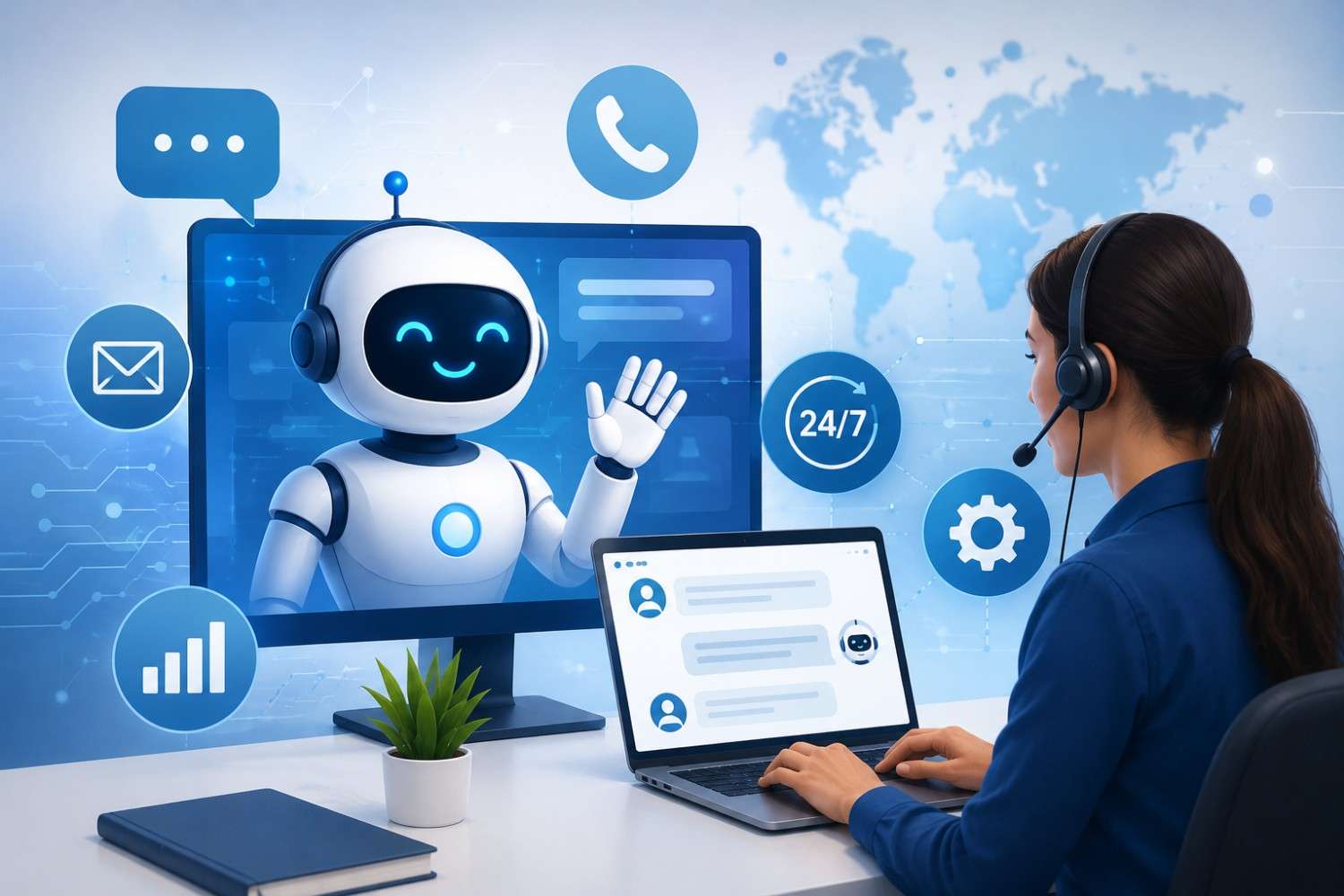
 Technical support requires intensive knowhow, empathic tonality, and timely responses. AI assists greatly in such efforts via LLM powered chatbots that leverages predictive analytics for personalized fixes and uses processing advantages for ticket management. As AI systems can act standalone when not supporting human agents, they can shorten wait durations, reduce overhead, and provide solutions to customers at scale. 


What Are the Key Benefits of AI-Powered Technical Support for Businesses?            

 24/7/365 Availability & Quick Responses: No matter the time zone your customers are located in, AI powered technical support is always available, and indefatigably so. This can help avoid hiring night shift employees or paying regular shift personnel for unneeded amounts of overtime. 


Assisting Human Support: Internal employees are aided with FAQ answers, call rerouting, knowledge base information, past conversation histories, and more to make their support efforts easier and quicker. They also handle repetitive tasks, freeing up human agents to focus more on nuanced problems and important tasks instead. 


Personalized, Multichannel Support: AI can meet customers across a wide variety of mediums such as calls, voice chats, text chatboxes, emails, social media platforms and more, giving businesses better reach. Moreover, they can dynamically tailor their responses and recommendations based on individual customer data to establish better and stronger connections. 


Scalability: AI with its massive processing power can handle tickets of virtually any volume while knowing which tickets to prioritize before others. Unlike human agents, AI is not prone to error or performance downturns while juggling huge numbers of tickets simultaneously, and can keep its level of precision and tonality intact for customer bases of companies of all sizes. 


How Can Businesses Successfully Implement AI in Technical Support Services?        

Conventional technical support must be augmented and not entirely replaced with AI if a business hopes to make the most out of the new technological advantage AI offers.  


Identify Needs: Figure out which particular areas, processes, etc. will benefit most from AI implementation. Define measurable objectives like improving customer satisfaction, shortening issue resolution durations, and minimizing repeat tickets. 


AI Stack & Toolkit Selection: Skilled technical support service providers can choose the right AI tech stack and tools that answer your needs best, after having done much research and having had much experience working with them in the past. They evaluate these tools for scalability and smoothness in integration. 


Implementation Planning: This mostly involves but is not limited to evaluating system specifications & migration techniques, allocating budget & resources, developing initial milestones & timelines, and crafting backup plans for minimizing service disruptions & maximizing business continuity.  


Integration: AI systems need to be evaluated at every stage to ensure that they properly mesh with CRM and other kinds of internal systems. Tests should be conducted to ensure that data loss or other issues are either prevented or resolved before handling the first customer in live chat. 


Training Internal Staff: Existing teams must be regularly provided with seminars and workshops that build their technical prowess in AI as well as their overall use of AI to enhance their support efforts.  


Post Deployment Evaluation: Performance tracking, conversation review, feedback assessment, and data driven improvements based on metrics like overall response durations and rates of issue resolution will make AI systems improve rather than backtrack support efforts well into the future. 


Final Thoughts 

LLM technologies like ChatGPT, Claude & Gemini are making an impact not only within their chat windows but also on wider areas of business applications, infrastructure and processes. One such area is technical support services. AI can make technical support feel more conversational, support a vast range of languages & dialects, pinpoint fixes human agents may miss, craft creative decision trees and more. Businesses must carefully vet AI powered remote technical support service providers for their portfolios and track records, while having measured expectations of what they expect from such AI implementation.              

Call-To-Action 

 Regardless of the size of the business you represent, if you’re considering hiring AI technical support assistants for your projects, VoxtenD is here to help. Our suite of VA services covers all aspects of technical support, AI, and beyond, ensuring that your business gets the help it needs, no matter the size or needs of your business. With round the clock availability, VoxtenD is your partner in achieving business success. Contact us today to explore how our services can benefit your business. 


Frequently Asked Questions 

Q1: What is AI-powered technical support? 

A: As the name suggests, onshore or remote technical support, when enhanced with tailored AI integrations, can supercharge support efforts. Self learning & self improving machine learning (ML) principles combined with natural language processing (NLP) make AI a solid enhancement on top of existing internal or outsourced technical support processes.  


Q2: Can AI replace human technical support agents? 

A: Human technical support agents will always be needed to tackle high level and specific/niche tasks that fall outside the purview of AI, while AI can aid human agents with suitable responses, important summaries of company policies & product data, and more. The best technical support services combine the advantages of both human agents and AI systems working collaboratively. 


Q3: What are the benefits of AI in technical support services? 

A: AI has been massively beneficial for onshore & remote technical support services especially when it comes to quick issue resolution, 24/7/365 availability, conversation retention/summarization/review/retraining, ticket management, reduction in manpower/training/overhead/operational costs, predictive analytics for preemptive workload handling & bug fixes, and tonal & output consistency. 


Q4: Is AI suitable for small and medium-sized businesses? 

A: For small and medium businesses that cannot spend much overhead on huge teams of dedicated technical support agents, implementing AI as outsourced technical support is a suitable step as AI can troubleshoot and deal with multiple issues at once at any time of the day, assist existing teams with issue resolution, dialogue scripts and company data reminders, and reduce overall workload especially when it comes to repetitive & mundane tasks. 


Q5: How can VoxtenD help businesses implement AI-powered technical support? 

A: VoxtenD’s professional technical support services are powered with AI, helping businesses with integrating AI with their virtual chatbots, building a strong knowledge base on company data with retrieval augmented generation (RAG) principles, contextual & self improving AI, and predictive analytics that allow AI to resolve issues & manage unforeseen workloads before they arise.