

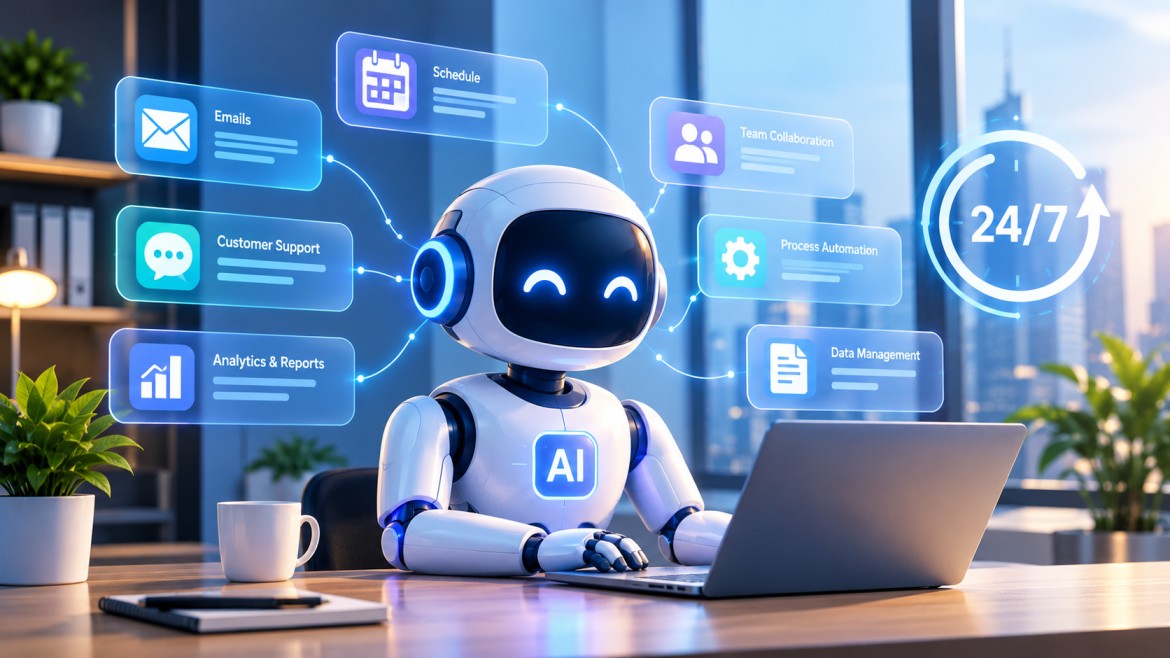
What If Your Business Had an AI Agent Working 24/7? 

What If Your Business Had an AI Agent Working 24/7? 

It’s 2 AM and nobody’s in the office. Somebody on your website just typed a question anyway, and got a real answer back in seconds. A sales lead just got qualified before your team even woke up. This isn’t a hypothetical anymore. AI agents for business are already doing this work, quietly, around the clock, while owners and managers sleep. The question isn’t whether AI agents can help. It’s how much time and money your business loses every day it goes without one. A 24/7 AI agent doesn’t need a lunch break, and it won’t call in sick on a Monday. Ask it the same question for the fiftieth time and it still won’t lose patience. It just works. This piece looks at what these agents actually do, how they’re changing customer support and internal operations, and what it takes to bring one into your business. 


How AI Agents Are Transforming 24/7 Business Operations  

Most businesses still run on human hours, like it or not. Support teams clock out. Sales reps go to lunch. Approvals sit in someone’s inbox until Monday. Customers and employees don’t work on that schedule anymore, and they’ve stopped expecting businesses to either.    

AI agents for business close that gap. A chatbot follows a script. An AI agent doesn’t. It reads the situation, decides what’s allowed, and acts on its own across several steps. A customer emails about a late order at 11 p.m.; the agent opens the ticket, checks the shipment, refunds if policy allows, and logs it, before anyone’s awake.  

This shift is really about availability. A 24/7 AI agent means your business has a presence at 3 a.m. on a Sunday just as reliably as at 10 a.m. on a Tuesday.   

There’s a cost side too. Hiring people to cover nights, weekends, and overflow is slow and expensive. AI business automation solutions take a different path: a business handles more orders, more questions, more everything, without staffing up at the same rate. Growth and headcount stop moving in lockstep.  

Smaller companies use AI agents to compete with rivals who have far bigger support and operations teams, simply by never leaving a customer or a process waiting.   

It’s not just one industry either. A retailer might lean on an agent for overnight order questions, a clinic for routine patient queries, a logistics outfit just for shipment status at 4 a.m. 


How AI Agents Improve Customer Support and Engagement 

 
Customer support tends to be where businesses try this first, and that makes sense. Order status, return policy, pricing, password resets, the same dozen questions come around again and again. An agent handles them the moment they’re asked.   

Speed isn’t the point, though. A good AI agent tracks what’s already been said. It can pull up order history, match its tone, and loop in a person only when the problem needs one. Done well, that handoff doesn’t feel like getting bounced around. It feels like the business already knew what was going on.    

Engagement improves for a simpler reason too. People get answers when they actually have the question. Nobody comparing products at midnight wants to wait until 9 a.m. for a reply. A 24/7 AI agent skips that wait, and it shows up in the numbers: more conversions, fewer abandoned carts, more repeat customers.    

This looks different from the old chatbot days. An agent can follow up on an abandoned cart, check in after a ticket closes, or catch early signs of frustration before it becomes a bad review. None of that waits for someone to ask. Speed and a personal touch aren’t a trade-off anymore, a good agent does both at once. 


How AI Agents Support Employees and Improve Productivity  

Everyone talks about the customer-facing side, but what happens inside the business matters just as much. A lot of a normal workday goes to things that don’t need a human brain: finding a meeting slot for six people, pulling the same report again, chasing an approval that’s been sitting for two days.  

AI agents take that work off their plate. A rep heading into a call can ask the agent to pull up everything on that client instead of hunting across five tabs. HR doesn’t have to answer the same onboarding question for the fortieth new hire, an agent can, freeing people for the parts of the job where judgment actually matters.    

This matters for retention too. Cut the repetitive busywork and people generally stay more invested in the work that feels like theirs. A good AI agent development company knows this, which is why internal agents usually get built to sit inside the tools a company already has. Nobody has to learn a new system. The help just shows up inside the one they’re already using.    

The productivity gain compounds over time. Small pockets of saved time, ten minutes here, twenty there, add up across a team and a year into a real shift in output.    


Final Thoughts 

If you’re weighing whether this fits your business, the smartest first step is usually a conversation with an AI agent development company that can look at where your team is losing time and build something to fix exactly that. The technology is ready. The real question at this point is just when, not if. It’s usually not the biggest budgets winning this. It’s whoever rethinks how support and day-to-day operations get handled, and builds AI business automation solutions around how their business actually works instead of grabbing something off the shelf.


Call-To-Action  

Regardless of the size of the business you represent, if you’re considering hiring AI agent experts for your projects, VoxtenD is here to help. Our suite of VA services covers all aspects of AI agents, agentic AI and beyond, ensuring that your business gets the help it needs, no matter the size or needs of your business. With round the clock availability, VoxtenD is your partner in achieving business success. Contact us today to explore how our services can benefit your business. 


Frequently Asked Questions 

 
Q1: What is an AI agent for business? 
 
A: It’s software that can understand a request, make a decision within its rules, and carry out a task on its own: answering a customer, processing an order, moving a workflow forward, without a person handling every step. 


Q2: Can an AI agent really work 24/7? 
 
A: Yes. A 24/7 AI agent has no shift schedule and no time zone problem. It keeps running, handling customer questions and routine tasks whenever they arrive, which is the main reason businesses adopt one for support and operations. 


Q3: How can AI agents benefit businesses? 
 
A: Faster response times, less on staff’s plate, and operations that don’t stop at 5 p.m. AI business automation solutions like these also bring costs down over time, even as customers and employees get what they need faster. 


Q4: Are AI agents better than traditional chatbots? 
 
A: Usually, yes. A traditional chatbot is stuck following a script and falls apart once a question wanders outside what it was programmed to answer. An AI agent reads the context, makes its own call within its limits, and can carry a task through several steps, which makes it far more useful outside a tidy, predictable conversation. 


Q5: How can a business implement an AI agent? 
 
A: Most businesses start small: pick one task that happens often, customer support or scheduling are common, and build an agent for that. An experienced AI agent development company usually speeds this up, since they’ve already handled the design, testing, and integration work. 
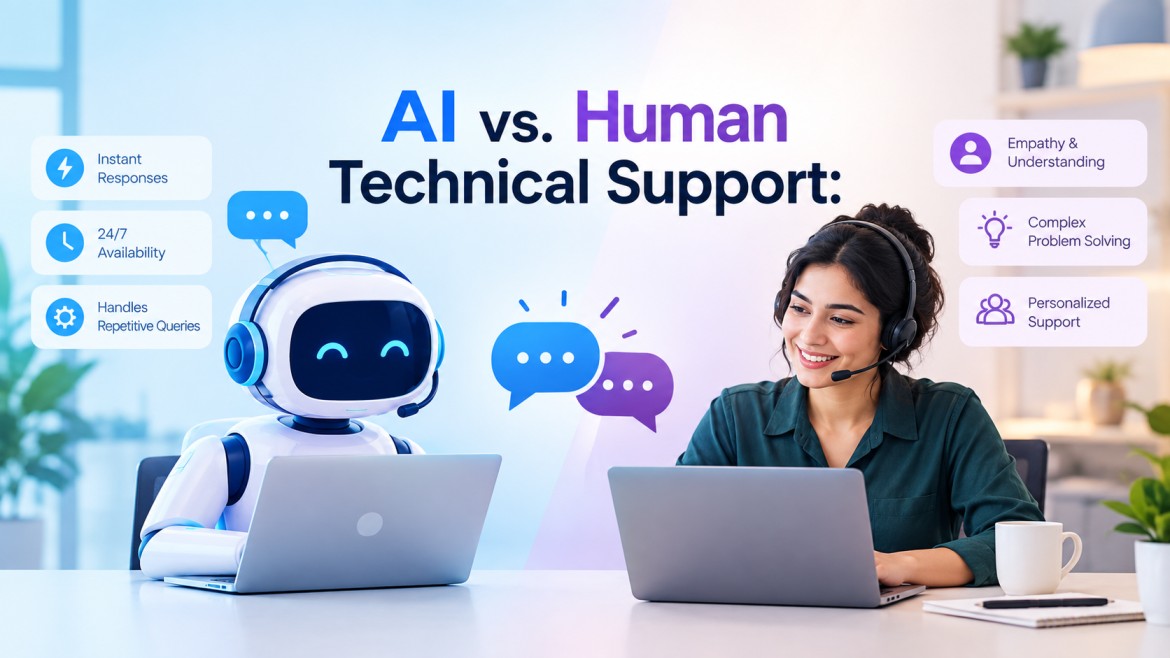
 

AI vs. Human Technical Support: Finding the Right Balance 

AI vs. Human Technical Support: Finding the Right Balance 

Your internet drops at 11 PM on a Sunday, right before a deadline you can’t move. Do you want a chatbot walking you through the same three router resets, or a person who can actually tell a dying modem from a bad cable? That’s the question underneath a debate a lot of support teams still haven’t settled. Companies keep weighing AI technical support against the traditional human help desk, but it’s rarely either-or. Figure out where AI vs. human technical support earns its keep, and honestly, most of the rest of the strategy falls into place. 


AI vs. Human Technical Support: What’s the Difference? 

AI technical support runs on pattern recognition. Feed a chatbot enough old tickets and it starts recognizing the obvious stuff: a forgotten password, an app stuck mid-update, a billing question with just one right answer. It doesn’t care what time it is. Three in the morning gets the same response as three in the afternoon. It’ll juggle a hundred conversations at once and still ask you to restart the device, never once sounding annoyed.  


Human technical support runs on judgment. A good engineer picks up on the fact that a customer’s short, clipped answers mean something the ticket never says outright. Sometimes that means going off-script, or asking a question no flowchart accounts for. Other times it’s a judgment call made because nothing on file matches what’s happening. Chatbots still can’t do that, and not for lack of trying.  


Forget speed versus quality. That’s not really where AI vs. human technical support splits. It’s breadth versus depth. AI covers more ground faster, while humans go deeper once the ground gets uneven. A password reset rarely needs a person. A recurring server crash tied to a client’s custom integration almost always does.  


Get this wrong in one direction and customers get stuck with a bot that can’t escalate. Get it wrong the other way and your best engineers spend the afternoon resetting passwords instead of solving problems only they can solve.  


The Benefits of a Hybrid AI and Human Support Model 


The best support desks let AI technical support take the first swing at every ticket, and bring in a person the moment a case needs actual problem-solving instead of a script. 

Response times are the easy win. A ticket gets acknowledged the second it’s filed, routine problems close out in minutes, and anything that needs a person lands on the right desk without the customer repeating themselves.  

Capacity is the less obvious win. Automation soaks up the repetitive stuff most help desks deal with daily, freeing engineers to spend their time on the complex cases nobody else can touch.  

Hybrid models improve consistency too. Run the same troubleshooting steps a thousand times and you get a thousand identical outcomes, not different ones depending on the agent. Then a person takes over where it counts.  

This is also where AI strategy for businesses starts to matter beyond the support desk itself. What to automate, what to escalate, and how the handoff actually works, that’s a decision for leadership, not a checkbox in an IT ticket. 


The Future of AI-Powered Technical Support 


Scripted chatbots are already old news. The systems coming next read server logs, cross-check known issues, and hand a human agent a suggested fix before the agent finishes reading the ticket, more of a second pair of eyes than a stand-in. A few tools now catch a pattern in performance data and flag a hardware failure before the customer notices anything’s wrong.  

Phone support is catching up too. The kind of voice AI that sounded robotic five years back now holds a conversation you’d barely clock as artificial. There’s quieter work happening behind the scenes too: AI combing through thousands of old tickets in an afternoon, catching a trend that would take a human analyst weeks to notice, then nudging engineers toward whatever’s causing the problem rather than the symptom customers keep complaining about.  

Put it all together and you still don’t get AI running a support desk by itself. It points toward AI becoming a more capable partner to the people who still make the final call on hard problems. For businesses shaping an AI strategy for businesses in this space, the near-term opportunity isn’t full automation. It comes down to wiring predictive tools more tightly into the humans who still handle the escalations, so problems get caught early and get solved fast once a person needs to step in.  

No two businesses land on the same formula here. A desk fielding mostly software bugs looks nothing like one fielding hardware failures, and the right split reflects that. What matters more than the ratio is whether a company chose it on purpose, not because a vendor’s demo made it look good. Start by mapping your ticket volume, then figure out which tickets need a human and which don’t.   


Final Thoughts 

This is usually the exact work an AI strategy consulting services partner gets brought in for, since companies are often too close to their own blind spots to see them clearly. Voxtend has watched this play out more than once: support desks that wanted the speed of AI without giving up the human touch their customers still expect. 


Call-To-Action 

Regardless of the size of the business you represent, if you’re considering hiring technical support experts for your projects, VoxtenD is here to help. Our suite of VA services covers all aspects of technical support and beyond, ensuring that your business gets the help it needs, no matter the size or needs of your business. With round the clock availability, VoxtenD is your partner in achieving business success. Contact us today to explore how our services can benefit your business. 


Frequently Asked Questions 

 
Q1: Is AI better than human technical support? 
 
A: Neither wins outright. AI technical support is faster and always available for routine issues, but humans win once judgment and emotion enter the picture. The setups that work best don’t pick one. They just match the tool to the ticket, instead of forcing every case through the same channel. 


Q2: What are the benefits of AI in technical support? 
 
A: It closes out simple tickets instantly, never clocks out, and cuts wait times. That frees engineers for harder cases, and it hands support teams a clearer picture of which issues keep coming back, which used to take weeks to spot manually. 


Q3: When should a technical support issue be transferred to a human? 
 
A: Hand it off the moment a problem stops matching anything in the system, or when it’s tangled up in something account-specific. Same goes for when the customer’s patience is clearly gone. A well-designed hybrid setup catches those signals on its own, so nobody has to ask twice for a real person. 


Q4: Can AI replace technical support engineers? 
 
A: Not fully, and not anytime soon. AI handles the repetitive, high-volume stuff fine. What it still can’t do is make a judgment call, improvise a fix that’s not in any manual, or work through a genuine edge case, and those still need a person. Most industries are heading toward augmentation, not replacement, whatever the marketing decks say. 


Q5: What is the best approach to combining AI and human technical support? 
 
A: Map your ticket volume and complexity first, automate the routine layer, then build clear rules for escalating everything else. A lot of businesses bring in AI strategy consulting services to get that split right from day one, because fixing it after customers are frustrated costs more than planning ahead. 

What If Your Next Review Started With an AI Agent? 

What If Your Next Review Started With an AI Agent? 

Most reviews start the same way: someone opens a spreadsheet, scrolls through months of scattered notes, and makes a call that’s part data, part memory. An AI agent for business reviews skips that step. It pulls the records, spots the patterns, flags what looks off, all before the meeting even starts. 

Reviews don’t fail from lack of effort. They fail from lack of time. Managers running reviews for eight people are triaging, not analyzing. Sales leads prepping a Quarterly Business Review (QRB) are doing the same thing with twenty accounts and one afternoon. Agents don’t replace the judgment call. They remove the grunt work that used to eat the time you needed for it. This is not a new thing in the work culture. Teams are already running AI agents quietly in the background of review cycles, pulling data overnight, building drafts before anyone logs in. The interesting part isn’t that it’s automated. It’s what that frees people up to actually do. 


How AI Agents Are Changing the Review Process 

The review process used to run on whatever a person could remember and whatever they had time to pull up manually. Now it runs on whatever the system already gathered overnight. The real change is not just about forming smarter opinions. It is basically having faster and wider access to facts before the conversation even starts. An AI agent for business reviews makes this possible in a more structured and efficient way. 

Three changes are driving this: 

  • Reviews used to be backward looking by necessity. Pulling last quarter’s numbers took long enough that nobody had bandwidth to also check this week’s trend line. Agents remove that tradeoff. A reviewer can now see both the historical baseline and the most recent shift in the same document. 
  • The prep work used to fall on whoever had the least time. Ironically, the busiest people such as the team leads, account managers, department heads, did the most manual data gathering, because nobody else had context on what to extract from each file. Agents flip that. The person with the least time now gets the most complete brief, because the agent did the basic groundwork. 
  • Reviews used to be siloed by source. HR data lived in one system, project data in another, financials in a third. Nobody cross-referenced them because it took too long. Agents don’t care how many systems they’re pulling from. Cross referencing five sources costs the same as cross referencing one. 

None of this changes what a good review is supposed to do. It still needs a human making a call and standing behind it. What changes is how much time the human has to spend sorting through information to get there. 


Using AI Agents to Collect and Analyze Review Data 

Assembling review data eats most of the time. Deciding what it means takes the rest. That ratio is backwards, and it’s the first thing agents fix. 

Here’s what changes with an AI agents for business reviews. 

  • They check more sources than a person will. A manager checks the project tracker and maybe skims the project management tool. An agent cross-references the tracker, calendar data, ticket resolution times, and peer feedback before the workday begins. It’s not doing anything a person couldn’t do. It’s doing everything a person wouldn’t have time to do. 
  • They catch contradictions humans skim past. A self review claims someone led a project. The project tool shows someone else as a lead. A vendor claims faster response times this quarter; the ticket data shows the opposite trend. These aren’t dramatic discoveries. They’re the quiet mismatches that get missed when someone’s reading fast under deadline pressure but get caught when a system is reading literally, line by line, with no fatigue. 
  • They clean up messy inputs. Reviews get pulled from a CRM, a manually updated spreadsheet, a survey tool, an email thread, none of which speak the same format or run on the same timeframe. Part of what makes AI agents for performance reviews genuinely useful is the unglamorous work of reconciling all of that before a human ever looks at the numbers. Nobody wants to spend twenty minutes figuring out why one system says “Q3” and another says “July to September.” The agent already sorted that out. 
  • They keep a running history, not just a snapshot. A single review document is a moment in time. An agent that’s been quietly logging data across every cycle builds something closer to a timeline, which becomes far more useful the second or third time around, because now there’s a pattern to check the current numbers against. 

The output is not just a decision. It’s a clean, cross referenced starting point, the part that used to take three hours and now takes ten minutes. What a reviewer does with those ten extra minutes is the part that actually matters. 


AI-Powered Insights for Better Review Decisions 

Collecting data is step one. What an AI agent for business reviews does with that data is where the real impact comes from.  

  • Trend direction matters more than snapshots. Not “40 tickets closed last quarter” but “tickets closed have dropped three quarters running.” A single number tells you where things stand. A trend tells you where they’re headed, which is usually the more urgent question in a review. 
  • Comparative context turns a number into information. Forty tickets means nothing without a baseline: team average, prior period, stated goal. A good agent attaches that baseline automatically instead of leaving the reviewer to go find it, which is usually the step that gets skipped when time is short. 
  • Contradiction flags keep the agent honest. When self assessment and system data disagree, the agent surfaces both and lets the reviewer ask why. It doesn’t quietly pick a side. That distinction matters. An agent that resolves disagreements on its own is making a call it shouldn’t be making. 
  • Risk surfacing catches problems early. In a QBR, this looks like flagging a client whose usage dropped 30 percent eight months before renewal, the kind of early signal that gets buried in a spreadsheet nobody reopens until it’s already too late to act on it. 
  • Weight is more important than volume. Not every data point carries the same importance. A missed deadline on a low priority task isn’t the same as a missed deadline on a client facing deliverable. AI Agents that rank findings by actual impact, instead of just listing everything they found, save reviewers from digging through noise to find the two things that matter. 

This is where AI agents for decision making earn trust or lose it. An agent that just outputs “promote this person” or “cut this vendor” with no reasoning shown is a black box, and nobody should stake a real decision on a black box. The better pattern is simple: Show the data, show the pattern, show why it’s worth a second look, and leave the actual call to the person accountable for it. 


Conclusion 

None of this makes reviews easier in the sense of requiring less thought. If anything, a good AI agent hands the reviewer more to think about, because it surfaces things that would have stayed buried before. What it removes is the wasted hour spent just getting to a starting point. 

The businesses getting real value out of AI agent for business reviews aren’t the ones treating agents as a replacement for judgment. They’re the ones treating agents as a research assistant that never gets tired, never skips a source, and never forgets what happened last quarter. The review still comes down to a person deciding what the numbers mean and what to do next. That person just walks in better prepared than they used to. 

If your next review starts with an AI agent instead of a blank spreadsheet, the meeting doesn’t get shorter. It gets sharper. That’s the actual upside, and it’s a lot less dramatic than the headlines make it sound, which is probably why it’s already happening quietly inside teams that never announced it. 


FAQs 

  1. What is an AI agent in the review process? 

It’s software that goes out and gathers review relevant information on its own, pulling information from tools like project trackers, CRMs, or survey platforms, instead of waiting for someone to ask it a question one at a time. The difference between this and a basic chatbot comes down to initiative. A chatbot answers what you type. An AI agent fetches the update itself, on a schedule or trigger, before anyone thinks to ask. 


2.  How can AI agents improve business reviews? 

  AI agents improve business mainly by taking prep time from hours down to minutes. That freed up time doesn’t disappear. It goes straight into actually interpreting the data instead of hunting for it. AI Agents also catch the small inconsistencies that slip through when someone’s reading fast under deadline pressure, a metric that doesn’t match a claim, or a trend that’s been quietly declining for months without anyone noticing. 


3. Can AI agents replace human decision-making during reviews? 

No. Human are integral part of the decision making especially during a review process. Agents are strong at pattern recognition across large, messy datasets, exactly where humans are slowest and most error prone. But reviews usually hinge on context an agent doesn’t have access to. Why a project actually slipped. What a client relationship feels like beyond the usage numbers. Whether someone’s rough quarter was a real problem or a one off. Agents handle the data. Humans handle the judgment. Swapping that order is where things go wrong. 


4. What information can an AI agent analyze during a review? 

An AI agent can work on numerous information during a review. It depends entirely on what’s connected, but the common sources include project management data, CRM and sales activity, support ticket volume and resolution time, calendar and meeting patterns, survey or feedback responses, and prior review history for tracking trends over time. The more sources an agent can reach, the more it can cross reference, and that’s usually where the sharpest insights show up, in the gap between two sources rather than inside either one on its own. 


5. How can a business start using AI agents for reviews? 

Start narrow. Pick one review type, one team’s quarterly reviews, or QBRs for a handful of accounts, and connect two or three data sources that already exist rather than trying to wire up everything on day one. Run it alongside the existing manual process for a single cycle so reviewers can compare the agent’s output against what they would have put together themselves. That side by side comparison is usually what builds real trust in the system, and it’s a far cheaper way to find the gaps than rolling it out company wide before anyone’s tested it.